Species → Bluestreak Cleaner Wrasse
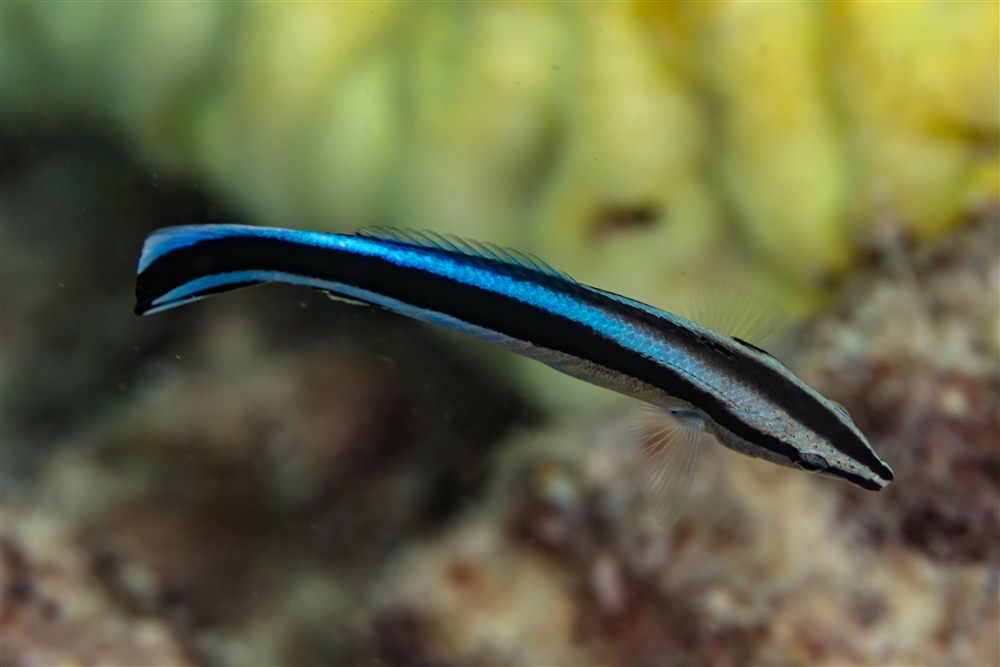
Bluestreak Cleaner Wrasse
Labroides dimidiatus
What if it disappeared?
Impact HighA single cleaner wrasse can perform more than 2,200 cleaning interactions a day, consuming more than 1,100 parasites — and a client fish's parasite load can increase 4.5-fold in just twelve hours when the cleaner is absent. Over a full year without it, entire generations of parasites build up without ever being removed.
DocumentedDetail
Grutter, A.S. (1999). Cleaner fish really do clean. Nature, 398, 672–673.
By tracking parasitic isopod (Gnathiidae) numbers on client fish over the course of a day, with and without access to the cleaner, the study provides the first direct evidence that cleaning genuinely reduces parasite load — rather than the cleaner simply feeding on mucus or healthy skin, as some had proposed.
After 8.5 years with no cleaner wrasse at all, experimental reefs show 37% fewer resident fish, 23% fewer species, and 65% fewer newly recruited juveniles than comparable control reefs where the species is present: the parasite load left unchecked ends up emptying the reef of part of its fish community.
DocumentedDetail
Waldie, P.A., Blomberg, S.P., Cheney, K.L., Goldizen, A.W. et Grutter, A.S. (2011). Long-Term Effects of the Cleaner Fish Labroides dimidiatus on Coral Reef Fish Communities. PLoS ONE, 6(6), e21201.
This removal experiment, one of the longest ever conducted on a reef fish, extends over nearly a decade a study begun by Grutter and colleagues in 2003. Reefs without cleaners averaged 561 resident fish versus 891 on control reefs, 15.5 species versus 20.1, and 11.6 visiting juveniles versus 33.2 — the study also establishes, for the first time, that fish with access to cleaning grow to a larger size than those without.
Over a century without cleaners, this decline would likely extend well beyond what the Lizard Island experiment measured: the reefs involved would probably settle into a permanently lower fish diversity, since cleaning stations had long served as gathering points that concentrated and anchored resident fish populations to a given site.
HypothesisOver a thousand years, other occasional cleaners — cleaner shrimp, juveniles of other fish species — would likely take on part of the vacated role, but without ever providing the same full-time service at the same scale: a structurally less diverse, less densely populated reef would probably remain the norm, rather than a return to the state seen with the cleaner wrasse present.
HypothesisDocumentation
-
IUCN Red List — Labroides dimidiatus, statut de conservation
Accessed August 14, 2026
-
Grutter (1999) — Cleaner fish really do clean, Nature
Accessed August 14, 2026
-
Waldie, Blomberg, Cheney, Goldizen & Grutter (2011) — Long-Term Effects of the Cleaner Fish Labroides dimidiatus on Coral Reef Fish Communities, PLoS ONE
Accessed August 14, 2026
Last verified: August 16, 2026