Species → Red kangaroo
Red kangaroo
Osphranter rufus
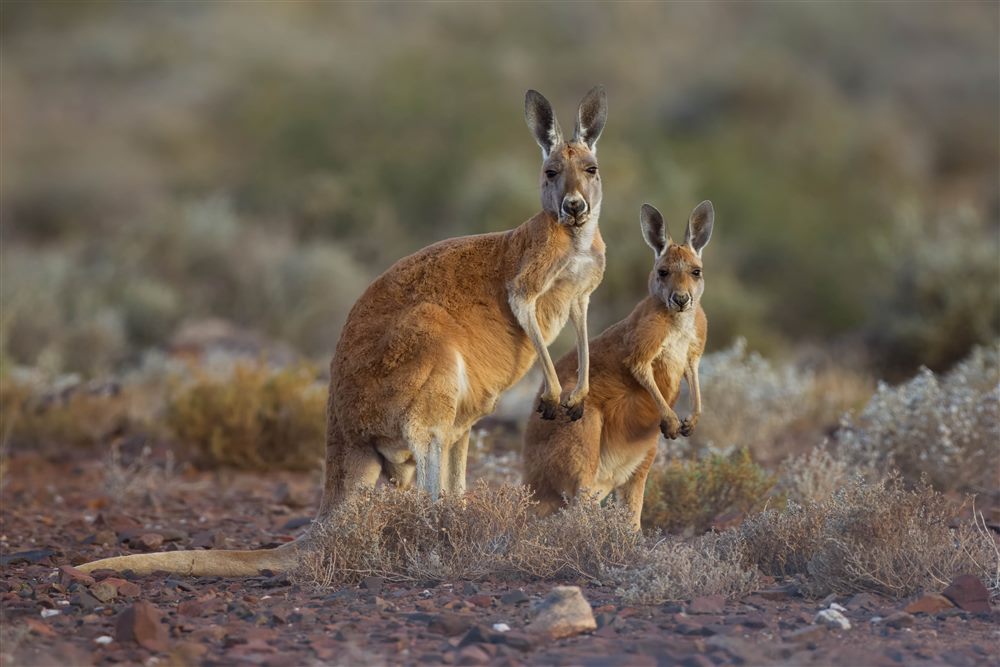
The red kangaroo lives in the arid and semi-arid interior of Australia, where its population has risen sharply since European colonization, boosted by artificial water points and the retreat of the dingo. Its IUCN status is Least Concern. By grazing, it keeps grass short and shapes the landscape's fire regime: this entry documents, at each horizon, what stopping that grazing would do to fine fuel, shrubs, and soil structure.
What if it disappeared?
Impact ModerateWithout red kangaroos grazing, pressure on the grass would ease almost immediately: a field study shows that a single dry season of dense grazing by the species (alongside rabbits) is enough to reduce grass biomass, compact the soil, and slow water infiltration — its removal should, in reverse, quickly bring back biomass and loosen the soil.
ExtrapolatedDetail
Extrapolation, en sens inverse, de Braden, J., Mills, C.H., Cornwell, W.K., Waudby, H.P. et Letnic, M. (2021). Impacts of grazing by kangaroos and rabbits on vegetation and soils in a semi-arid conservation reserve. Journal of Arid Environments, 190, 104526 — l'étude mesure l'effet de la présence de l'espèce, pas d'un retrait réel.
The study documents the effect of one dry season of dense grazing in a semi-arid reserve, without isolating the kangaroo's share of the effect from that of the rabbits present at the same site. Reversing this finding to describe the effect of its disappearance remains sound reasoning — the inverse of removed grazing pressure — rather than a direct exclusion measurement.
What's missing to confirm it: No real removal experiment (a plot where the species would be actively excluded) was found in the sources gathered here to confirm the effect reverses as expected, or how fast.
That ungrazed grass would build up over several years rather than a single dry season, forming a continuous layer of fine fuel that wouldn't exist under sustained grazing — ground more prone to wider, more intense bushfires across the arid and semi-arid landscapes the species occupies.
ExtrapolatedDetail
Extrapolation au-delà de Braden et al. (2021), qui établit la réduction de biomasse sous broutage sur une seule saison — aucune étude publiée ne prolonge cette mesure sur plusieurs années ni ne relie directement l'absence du kangourou roux au régime des feux.
The mechanism (less grazing, more herbaceous biomass) is documented over one season; extending it over a decade and linking it to increased fire risk draws on well-established fire-ecology principles in arid environments, not on a species-specific measurement.
What's missing to confirm it: No study directly measures fire regime in a landscape without red kangaroos over several years; the biomass-fuel-fire link remains a general principle rather than a local measurement.
Over a century, this altered fire regime and the lasting absence of grazing would likely remake the landscape itself: shrubs and young woody plants that the kangaroo would otherwise have kept in check would have a better chance of establishing, tipping part of the arid steppe toward denser shrub cover — a landscape noticeably different from the mosaic of close-cropped grass and scattered bushes typical of the Australian interior today.
HypothesisOver a thousand years, this drift toward a shrubbier landscape would settle in for good, with plant composition and soil structure different from those shaped by millennia of grazing by native large herbivores — a state that likely would not return to identical even if the red kangaroo came back.
HypothesisDocumentation
-
Osphranter rufus — IUCN Red List of Threatened Species
Accessed August 10, 2026
-
Kangaroo population estimates — Department of Climate Change, Energy, the Environment and Water (Australie)
Accessed August 10, 2026
-
Mitchell et al. (2023) — Differential developmental rates and demographics in Red Kangaroo populations separated by the dingo barrier fence, Journal of Mammalogy
Accessed August 10, 2026
-
Pople et al. (2000) — Trends in the numbers of red kangaroos and emus on either side of the South Australian dingo fence, Wildlife Research
Accessed August 10, 2026
-
Dawson et al. (2023) — Land use and dingo baiting are correlated with the density of kangaroos in rangeland systems, Integrative Zoology
Accessed August 10, 2026
-
Braden et al. (2021) — Impacts of grazing by kangaroos and rabbits on vegetation and soils in a semi-arid conservation reserve, Journal of Arid Environments
Accessed August 10, 2026
Last verified: August 16, 2026