Species → Greater Honeyguide
Greater Honeyguide
Indicator indicator
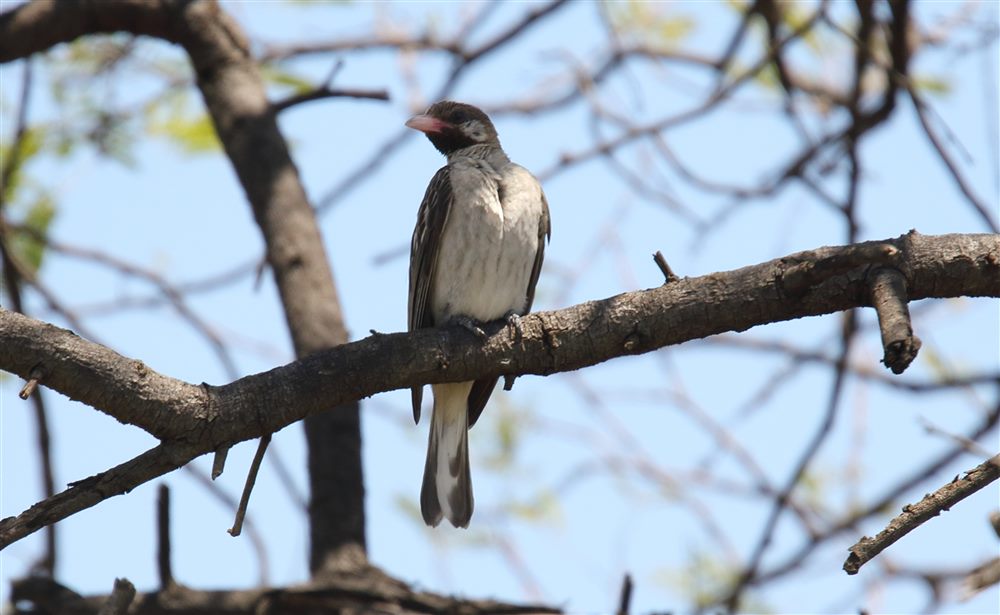
What if it disappeared?
Impact ModerateWithout the greater honeyguide, honey-hunters who collaborate with it drop straight back to their unaided nest-discovery rate — among the Hadza of Tanzania, up to 6.6 times fewer nests found — cutting off a resource that makes up 8 to 10% of this hunter-gatherer community's total diet.
DocumentedDetail
Wood, B.M., Pontzer, H., Raichlen, D.A. et Marlowe, F.W. (2014). Mutualism and manipulation in Hadza-honeyguide interactions. Evolution and Human Behavior, 35(6), 540–546.
The study draws on 146 field-tracked foraging trips (921 hours total) between 2001 and 2013 across twelve Hadza camps. Nests found with the bird's help are also significantly richer than those found without it — its disappearance would remove not just frequency but also the quality of what's found.
Among the Yao honey-hunters of Mozambique, the loss would be even sharper: without the bird responding to their traditional 'brrr-hm!' call, their chances of being guided to an actual nest fall from 54% to 16% — a shortfall that, year after year, compounds the one already measured among the Hadza rather than easing.
DocumentedDetail
Spottiswoode, C.N., Begg, K.S. et Begg, C.M. (2016). Reciprocal signaling in honeyguide-human mutualism. Science, 353(6297), 387–389.
By field-testing the traditional Yao honey-hunters' call against control sounds of comparable volume in the Niassa National Reserve, the authors show that the bird distinguishes the specific signal from mere noise, and that this response more than doubles the chance of being guided, and more than triples the chance of reaching an actual nest. Without the bird, this gain disappears entirely, not just partly.
Over a century without the greater honeyguide, the honey-hunting call itself would likely fade from local culture: it's a practice passed down and refined, generation after generation, only because the bird responds to it — with no response, no one would have a reason to learn how to give it, and the know-how would disappear along with the last hunters who practiced it with a living bird.
HypothesisOver a thousand years, this wouldn't just be lost know-how but a mutualism that could never simply spring back on its own: since the bird itself learns each human community's specific signal, generation after generation, even the honeyguide's return to a region wouldn't be enough to restart the collaboration — both sides would have to relearn it together, from scratch.
HypothesisDocumentation
-
IUCN Red List — Indicator indicator, statut de conservation
Accessed August 14, 2026
-
Spottiswoode, Begg & Begg (2016) — Reciprocal signaling in honeyguide-human mutualism, Science
Accessed August 14, 2026
-
Wood, Pontzer, Raichlen & Marlowe (2014) — Mutualism and manipulation in Hadza-honeyguide interactions, Evolution and Human Behavior
Accessed August 14, 2026
-
Spottiswoode & Wood (2023) — Culturally determined interspecies communication between humans and honeyguides, Science
Accessed August 14, 2026
Last verified: August 16, 2026