Species → Gopher Tortoise
Gopher Tortoise
Gopherus polyphemus
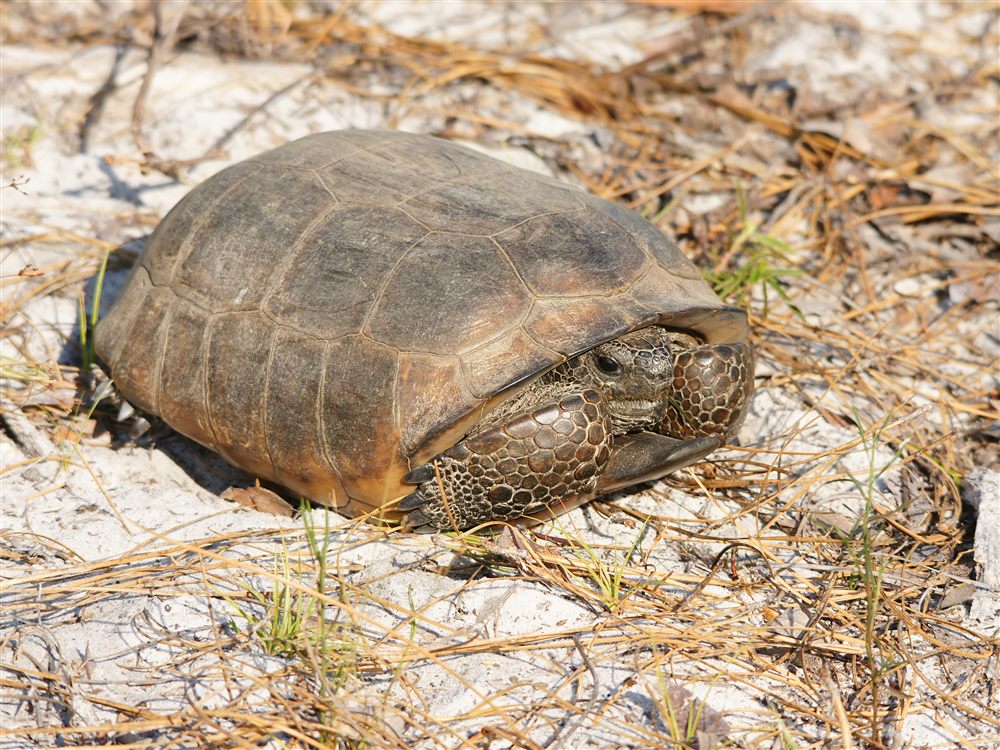
What if it disappeared?
Impact HighThe moment it disappears, the more than 350 species that depend on its burrows for shelter instantly lose their only source of fresh, maintained refuges: the eastern indigo snake has nowhere left to overwinter in the northern part of its range, and the gopher frog — most vulnerable right after metamorphosis — loses the shelter it depends on for food and protection.
DocumentedDetail
Florida Fish and Wildlife Conservation Commission (FWC). Gopher Tortoise Commensals.
The eastern indigo snake, a federally threatened species, uses gopher tortoise burrows as overwintering refuge in the northern part of its range — no other species in this savanna digs a burrow as deep or as durable. The gopher frog depends heavily on burrows for shelter and food, particularly right after metamorphosis. The FWC designates the gopher tortoise as a keystone species because it physically reshapes its environment to support hundreds of other organisms — so its disappearance removes that support all at once, not species by species.
Over ten years, with no new burrows dug or maintained, their density falls toward zero in affected areas — and since that density is directly tied to the diversity and evenness of the savanna's vertebrate community, that community likely becomes less balanced, dominated by a narrower set of species, without necessarily losing species outright.
ExtrapolatedDetail
Extrapolation à partir de Catano & Stout (2015), qui mesurent l'effet de la densité de terriers sur la diversité et l'équitabilité des communautés de vertébrés à des sites où le gophère est encore présent à densité variable, pas sur un gradient allant jusqu'à sa disparition complète.
The effect measured by Catano & Stout (2015) is a density effect, not a presence/absence effect: it was never measured at the point where burrow density reaches zero. Extrapolating a declining density gradient down to zero to predict the effect on diversity and evenness remains reasoning beyond the study, not a direct measurement.
What's missing to confirm it: Direct monitoring of sites where burrow density has actually reached zero, rather than an extrapolation from merely declining densities.
Over a century, with no other savanna species able to dig a burrow as deep and durable, the eastern indigo snake and the gopher frog would very likely have no comparable substitute shelter — a marked decline of these two protected species, possibly even their local disappearance in the areas most dependent on gopher tortoise burrows.
HypothesisOver a thousand years, the longleaf pine savanna itself would be changed: without the burrows that shelter hundreds of species from fire and extreme temperatures, only those able to survive without that underground refuge would persist over the long run — a narrower, more uniform animal community than the one the savanna held while the tortoise was digging there.
HypothesisDocumentation
-
IUCN Red List — Gopherus polyphemus, évaluation 2026 (Stemle, Howell, Tuberville et al.)
Accessed August 14, 2026
-
Center for Biological Diversity — International Assessment Finds Gopher Tortoise Is Critically Endangered
Accessed August 14, 2026
-
FWC — Gopher Tortoise Commensals
Accessed August 14, 2026
-
Catano & Stout (2015) — Functional relationships reveal keystone effects of the gopher tortoise on vertebrate diversity in a longleaf pine savanna, Biodiversity and Conservation
Accessed August 14, 2026
Last verified: August 16, 2026