Species → Dingo
Dingo
Canis lupus dingo
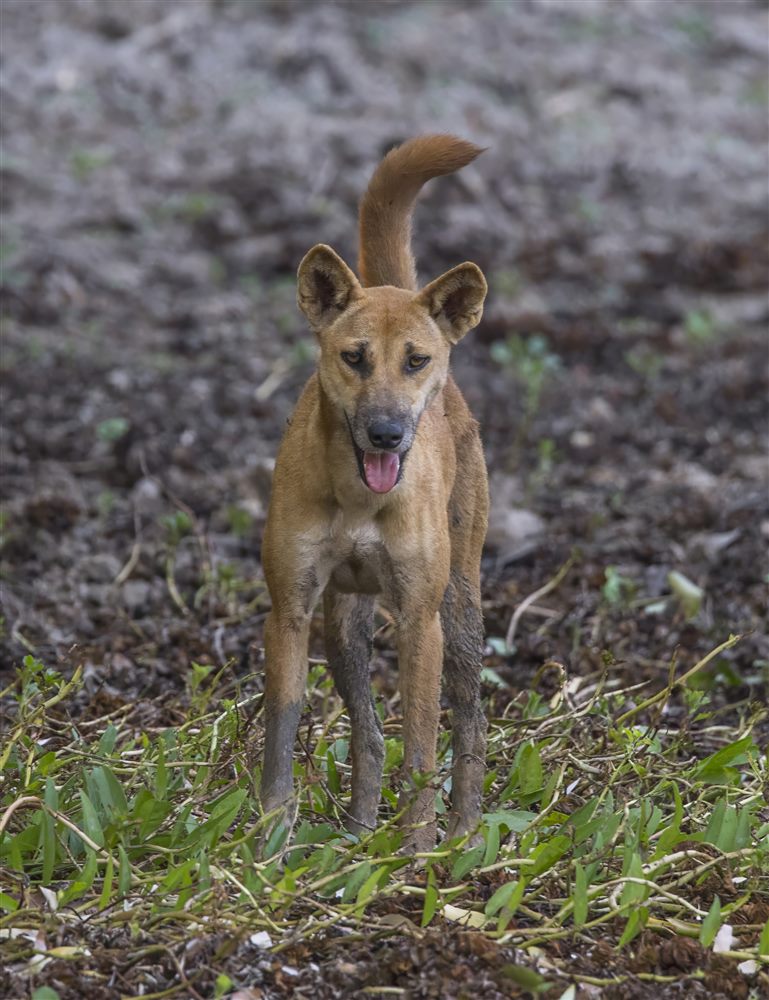
What if it disappeared?
Impact LowAs soon as the dingo vanished from a region, the competitive pressure it placed on foxes and feral cats for the same prey would fade almost immediately — that's what the correlation observed between dingo presence and reduced abundance of these two competitors, in areas where it still exists, implies.
ExtrapolatedDetail
Extrapolation à partir de Letnic, Ritchie & Dickman (2012), qui documentent une corrélation entre régions avec et sans dingo, pas un suivi avant/après sa disparition d'un même lieu.
This review synthesizes several field studies in which the presence of the dingo coincides with a reduction in the abundance of red foxes and feral cats, with documented benefits for certain native small mammal species vulnerable to these introduced predators. That this competition would fade almost immediately after a dingo's disappearance is a direct extrapolation of this correlation, not a before/after measurement.
What's missing to confirm it: The source rests on a comparison between distinct regions at a given point in time, not a temporal record of the same region before and after the dingo's disappearance — and more recent, larger-scale studies do not confirm this effect (see the next point).
But at a larger scale, in areas where the dingo has been absent for a long time, that expected rise in foxes and feral cats does not hold up reliably — the dingo does not systematically protect native wildlife from introduced predators, contrary to what the initial correlation suggested.
DocumentedDetail
Fancourt et al. (2019) — Do introduced apex predators suppress introduced mesopredators?, Journal of Applied Ecology.
Several studies published since 2018-2019, including multi-scale studies on dingoes and feral cats, do not confirm that the dingo spatially or temporally restricts feral cat activity at large scale. More than 130 peer-reviewed articles have discussed this hypothesis since the 1990s without reaching a definitive conclusion — a case where the literature remains actively divided, not simply insufficient.
Over a century, with no mechanism confirmed at large scale, the trajectory would likely depend far more on local conditions — available prey, other predators already present — than on any single rule applying across all of Australia: some regions would probably see more foxes and cats, others almost no change at all.
HypothesisOver a thousand years, Australia would likely have settled into highly varied local balances among foxes, feral cats, and native wildlife, with the dingo never again playing, anywhere, the single, systematic regulating role sometimes attributed to it.
HypothesisDocumentation
-
Dingo population estimates — Arthur Rylah Institute / Wildlife Victoria
Accessed August 10, 2026
-
Letnic, Ritchie & Dickman (2012) — Top predators as biodiversity regulators: the dingo, Biological Reviews
Accessed August 7, 2026
-
Fancourt et al. (2019) — Do introduced apex predators suppress introduced mesopredators?, Journal of Applied Ecology
Accessed August 7, 2026
Last verified: August 16, 2026