Species → Mexican Long-nosed Bat
Mexican Long-nosed Bat
Leptonycteris yerbabuenae
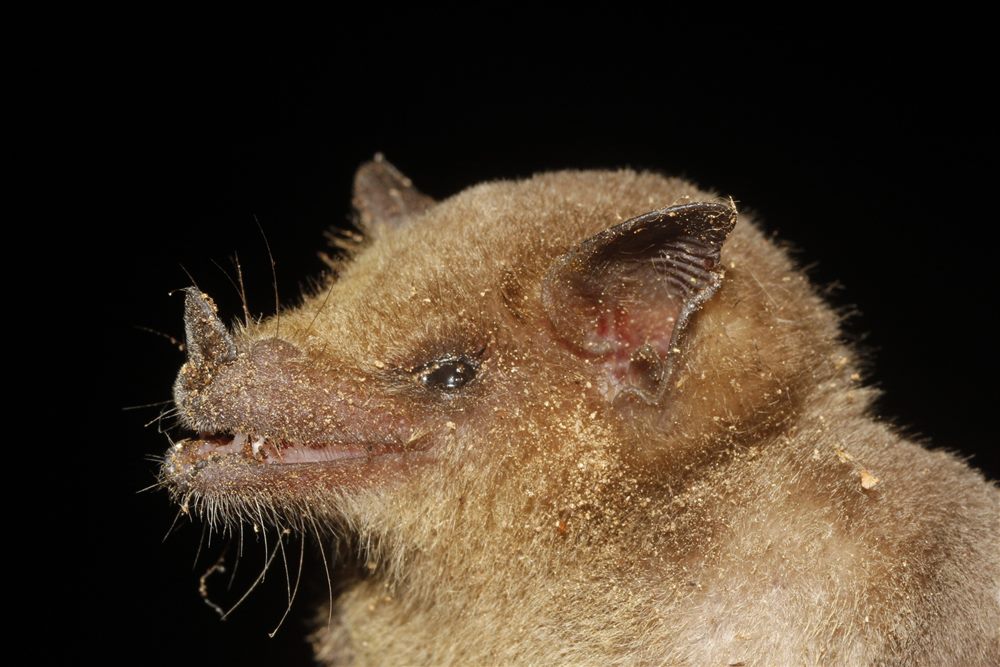
What if it disappeared?
Impact ModerateWithout bats visiting agave flowers at night, several agave species instantly lose their most efficient documented nocturnal pollinator: fruit resulting from Leptonycteris yerbabuenae pollination produces markedly more seeds than fruit pollinated by other visitors — a gap that closes as soon as the first flowering season passes without them.
DocumentedDetail
Pollination biology of Agave horrida (Agavaceae) in the Chichinautzin mountain range, Central Mexico. Botanical Sciences, 95(3), 423–431 (2017).
Agave flowers open at night and produce nectar suited to nectar-feeding bats. In several agave species, fruits resulting from pollination by Leptonycteris yerbabuenae produce significantly more seeds than those pollinated by other visitors — including some species used for tequila and mezcal.
Wild agaves flower only once, often after ten to twenty-five years of growth: the first generation to reach flowering without bats to pollinate it would likely set far fewer viable seeds than its parents did, slowing the establishment of new agave rosettes wherever backup pollinators such as night-flying hawkmoths are scarce.
ExtrapolatedDetail
Extrapolation à partir de l'écart de production de graines mesuré selon le pollinisateur (Pollination biology of Agave horrida, 2017), combiné au cycle de floraison monocarpique de l'agave, documenté par ailleurs — l'effet sur le recrutement de jeunes rosettes sur une décennie n'a pas été mesuré directement.
Agave is a monocarpic plant: it flowers only once after several years of vegetative growth, then dies. A pollination shortfall affecting an entire flowering cohort would therefore take a decade or more to show up as fewer established young plants, unlike a plant that reflowers every year and could compensate faster.
What's missing to confirm it: No demographic study has directly measured the recruitment rate of new wild agave rosettes in an area without bat pollinators over a full decade.
Over a century, this repeated pollination shortfall would fall almost entirely on wild agaves: plants grown for tequila and mezcal, nearly all propagated by cloned offshoots rather than seed, would remain largely unaffected. Generation after generation, wild populations that depend on sexual reproduction to renew themselves would lose an increasing share of their genetic diversity.
ExtrapolatedDetail
Extrapolation à partir du contraste documenté entre propagation clonale de l'agave cultivé et reproduction sexuée de l'agave sauvage, combiné à l'écart de production de graines selon le pollinisateur (Pollination biology of Agave horrida, 2017) : le raisonnement relie un mécanisme documenté à une perte de diversité génétique cumulée sur plusieurs générations, jamais mesurée directement.
Agave cultivated for tequila is almost always propagated by cloning (offshoots), which makes it largely independent of bat pollination — but wild agave populations, which sustain the species' genetic diversity over the long term, depend on it far more directly. Over several flowering generations, this uncompensated dependence would translate into cumulative genetic impoverishment.
What's missing to confirm it: The actual extent of genetic diversity loss in wild agave populations over several generations, due to insufficient pollination, has not been directly measured.
Over a thousand years, agave species with no effective backup pollinator would likely vanish from the driest parts of their range, lacking enough seed to renew their populations — while species that can rely on hawkmoths or other visitors would fare better. The resulting desert would not regain the same diversity of agaves, even if the bat eventually returned.
HypothesisDocumentation
-
Bat Conservation International — Leptonycteris yerbabuenae, statut et rétablissement
Accessed August 7, 2026
-
Pollination biology of Agave horrida, Botanical Sciences
Accessed August 7, 2026
Last verified: August 16, 2026