Species → Dung Beetle
Dung Beetle
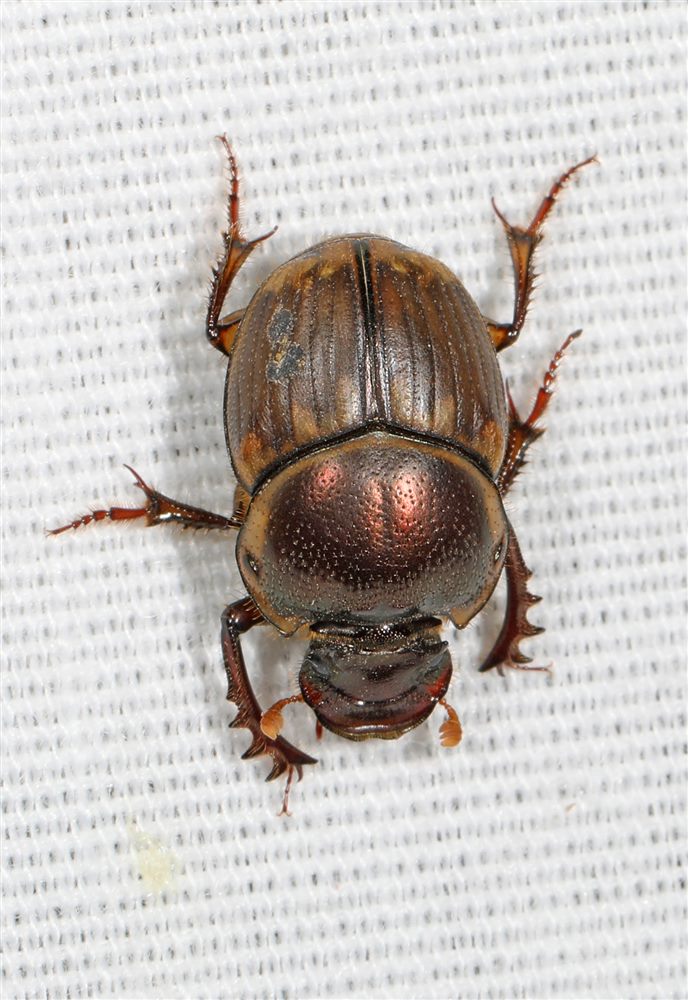
Digitonthophagus gazella
What if it disappeared?
Impact HighWithout dung beetles to bury soft cattle dung, each unburied pat can once again hatch up to 3,000 flies within two weeks while smothering the pasture underneath — exactly the state documented in Australia before 55 dung beetle species were introduced in 1968: native dung beetles, adapted to the fibrous droppings of marsupials, could not process this new kind of dung.
DocumentedDetail
Bornemissza, G.F. (1976). The Australian dung beetle project 1965-1975. Australian Meat Research Committee Review, 1976, 1–30.
With more than 20 million cattle each producing about ten pats a day, the absence of a dung beetle able to process this kind of waste amounted to a country-wide functional gap — not the absence of one particular species, but of an entire guild adapted to this type of resource. This state, measured before 1968, is what would return within the first year if the introduced beetles disappeared in turn.
After a decade without dung beetles to bury it, dung also stops feeding the soil: the nitrogen and phosphate it contains increasingly wash into nearby waterways instead of fertilizing the pasture, while unburied pats keep smothering the grass underneath — a double cost, to water and to forage, on top of the flies' return.
ExtrapolatedDetail
Extrapolation à partir de Bornemissza (1976), qui décrit le mécanisme d'enfouissement et son effet sur le retour des nutriments au sol plutôt qu'aux cours d'eau, sans mesurer directement ce qui se passerait après un retrait prolongé des bousiers introduits.
By burying dung within hours to a few days, the introduced beetles remove the flies' egg-laying site before hatching while returning the nitrogen and phosphate it contains to the soil. The link between their removal and a measurable rise in nutrient runoff into waterways hasn't been tracked directly over ten years — this is reasoning from the documented mechanism, not a measurement.
What's missing to confirm it: No direct measurement of nitrogen and phosphate loads in waterways after a prolonged removal of the introduced beetles was found — only the burial mechanism in their presence is documented.
The Australian program is only 58 years old — not quite a century, but the longest real period observed for this introduced species. Over that span, the population didn't just persist: it diversified into five genetically distinct groups, each adapted to its region's climate — evidence of a durable establishment rather than a one-off release that would have faded out over time.
DocumentedDetail
Rapalai, B.L., Simmons, L.W., Evans, T.A. et Kennington, W.J. (2024). Genetic and Phenotypic Divergence in a Dung Beetle 50 Years After Its Introduction to Australia. Ecology and Evolution, 14(11).
Genetic analysis of 187 beetles across 12 Australian sites shows significant genetic divergence between climatic regions, with divergence in digging-leg shape even more pronounced than neutral genetic divergence — a sign of active ongoing selection, not just a population frozen in place since its introduction.
Over a thousand years without the introduced dung beetle, nothing suggests Australia's native fauna would eventually adapt to soft cattle dung: it hasn't since cattle arrived. Pastures would likely, and durably, revert to the state documented before 1968 — abundant flies, unburied dung, nutrients lost to waterways rather than the soil — rather than settling into a new balance on their own.
HypothesisDocumentation
-
CSIRO — Dung beetles control buffalo and bush flies
Accessed August 7, 2026
-
Bornemissza (1976) — The Australian dung beetle project 1965-1975, Australian Meat Research Committee Review
Accessed August 7, 2026
-
Rapalai, Simmons, Evans & Kennington (2024) — Genetic and Phenotypic Divergence in a Dung Beetle 50 Years After Its Introduction, Ecology and Evolution
Accessed August 7, 2026
-
Beynon et al. (2015) — The application of an ecosystem services framework to estimate the economic value of dung beetles to the U.K. cattle industry, Ecological Entomology
Accessed August 7, 2026
Last verified: August 16, 2026