Species → Muskox
Muskox
Ovibos moschatus
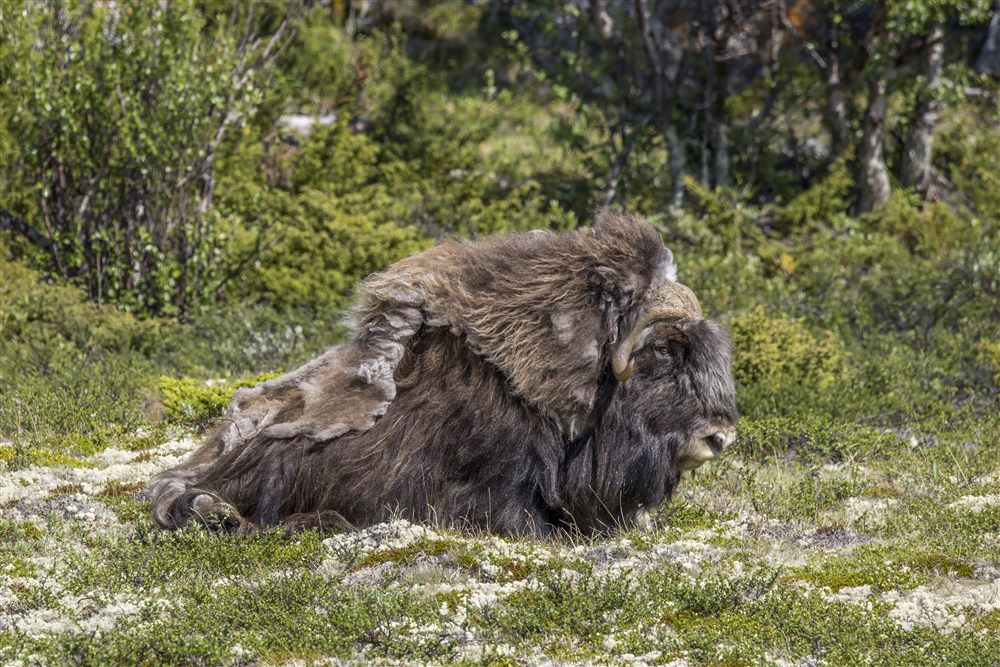
What if it disappeared?
Impact ModerateThe muskox grazes on grass, then goes to defecate in willow-filled hollows, leaving natural fertilizer there each year. Without it, that supply stops abruptly: the willows stop being fed at the expense of the grass grazed elsewhere.
DocumentedDetail
Mosbacher, J.B., Kristensen, D.K., Michelsen, A., Stelvig, M. et Schmidt, N.M. (2016). Quantifying Muskox Plant Biomass Removal and Spatial Relocation of Nitrogen in a High Arctic Tundra Ecosystem. Arctic, Antarctic, and Alpine Research, 48(2), 229–240.
A study conducted at Zackenberg, in northeastern Greenland. Despite high muskox densities, plant biomass removal remains low (less than 5% of available forage even late in the season) — so most of its effect on the landscape comes not from the amount grazed but from this spatial transfer of nutrients between habitats. Without the animal to carry it out, that transfer simply stops.
Without grazing from muskox and caribou, the two plants that already dominate the landscape — dwarf birch and grey willow — take over within about fifteen years, shading out the rarer plants, lichens and fungi until they vanish in places.
DocumentedDetail
Post, E. et al. (2022). Caribou and muskoxen buffer climate impacts for rare plants. Scientific Reports, 12, 1558.
A 15-year monitoring study at a Greenland site comparing grazed plots with grazing-exclusion plots. Without muskox and caribou to limit the spread of dominant shrubs, their canopy shading and leaf litter disadvantage less competitive species — a competition mechanism, not direct predation, but with a measurable effect on local plant biodiversity.
In other large tundra herbivores — horses, bison, reindeer — high animal density compacts the snow in winter, which shields the deep-frozen ground below from warming. A century without muskox trampling the snow of the Arctic tundra would likely have left that frozen ground less protected, even though the effect has never been measured directly in this particular species.
ExtrapolatedDetail
Extrapolation à partir de Beer, C., Zimov, N., Olofsson, J., Porada, P. et Zimov, S. (2020). Protection of Permafrost Soils from Thawing by Increasing Herbivore Density. Scientific Reports, 10, 4170 — étude qui ne porte pas sur le bœuf musqué.
The reference study modeled this effect using herds of horses, bison and reindeer as part of the Siberian 'Pleistocene Park' project, not the muskox. The physical mechanism (snow compaction reducing its insulating power) should apply to any large gregarious species living on snow-covered tundra, but no direct measurement confirms it for this particular species.
What's missing to confirm it: A direct measurement of the muskox's effect on permafrost temperature beneath its winter grazing areas, comparable to the one carried out for the Pleistocene Park herds, has yet to be done.
Over a thousand years, the tundra would likely settle into a lastingly different state: dwarf birch and grey willow would have taken over completely, and the deep-frozen ground would have stayed more vulnerable to thaw without compacted snow. Even if muskox returned after all that time, it would take decades to push back shrubs that well established.
HypothesisDocumentation
-
IUCN Red List — Ovibos moschatus, statut et estimation de population
Accessed August 7, 2026
-
Anderson et al. (2025) — Wolf density and predation patterns in the Canadian High Arctic, Journal of Wildlife Management
Accessed August 7, 2026
-
Mosbacher, Kristensen, Michelsen, Stelvig & Schmidt (2016) — Quantifying Muskox Plant Biomass Removal and Spatial Relocation of Nitrogen, Arctic, Antarctic, and Alpine Research
Accessed August 7, 2026
-
Post et al. (2022) — Caribou and muskoxen buffer climate impacts for rare plants, Scientific Reports
Accessed August 7, 2026
-
Beer, Zimov, Olofsson, Porada & Zimov (2020) — Protection of Permafrost Soils from Thawing by Increasing Herbivore Density, Scientific Reports
Accessed August 7, 2026
Last verified: August 16, 2026