Species → Axolotl
Axolotl
Ambystoma mexicanum
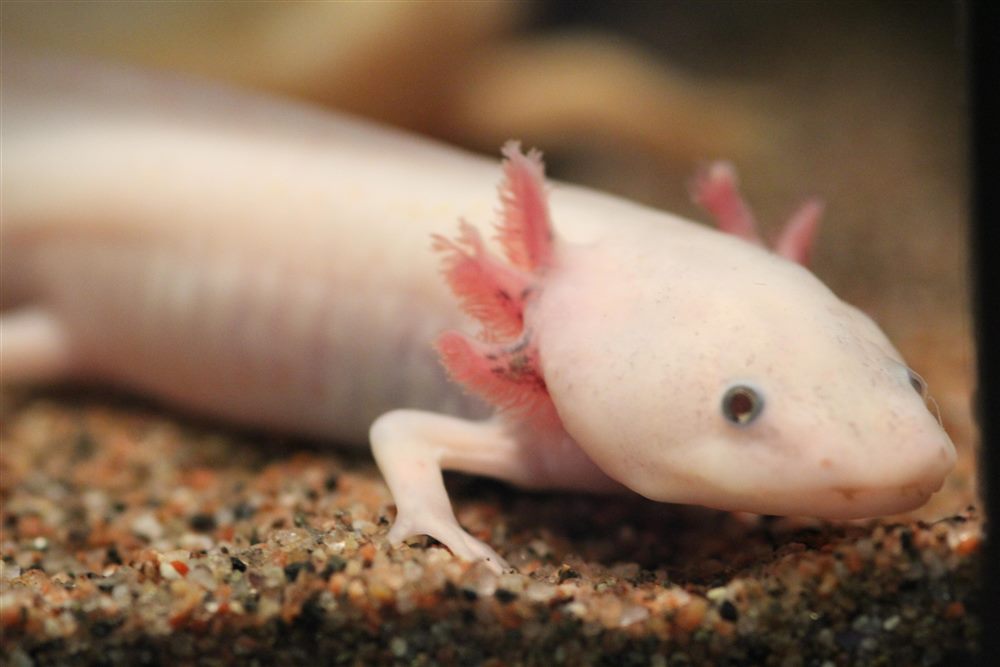
What if it disappeared?
Impact ModerateWithout axolotls hunting them, the small aquatic invertebrates it targeted most in the canals — ostracods, cladocerans, insect larvae — would likely see a local uptick within the first year after its disappearance: the usual pattern of predator release, before the network's other fish adjust their own hunting.
HypothesisThat vacancy likely wouldn't stay empty for long: in the Xochimilco canals, the axolotl already held the highest trophic position of the three main aquatic predators there, ahead of carp and tilapia — two introduced, more generalist fish whose diets already overlapped heavily with its own. Over ten years, these fish would most likely absorb most of its hunting role, without ever quite matching the same prey choices or the same selectivity.
ExtrapolatedDetail
Extrapolation à partir de Zambrano, L., Valiente, E. et Vander Zanden, M.J. (2010). Food web overlap among native axolotl (Ambystoma mexicanum) and two exotic fishes: carp (Cyprinus carpio) and tilapia (Oreochromis niloticus) in Xochimilco, Mexico City. Biological Invasions, 12(9), 3061–3069 — l'étude mesure la position trophique et le chevauchement de niche des trois espèces à une époque où l'axolotl est déjà très rare, sans mesurer directement le réseau trophique après sa disparition complète.
Using stable isotope analysis and stomach content data, the authors show the axolotl held the highest trophic position of the three species, with a narrower feeding niche (53 units) than carp (80) and especially tilapia (106) — these two more generalist fish already overlapped heavily with its diet. Their current dominance in canal biomass makes it plausible they would occupy most of the vacated space, without reproducing a specialist predator's selectivity.
What's missing to confirm it: No study directly measures the canal food web after a complete disappearance of the axolotl — the available figures describe its position while already rare, not a scenario entirely without it.
Over a century, Xochimilco would likely become a canal network where no other predator hunts quite the way the axolotl did: neither carp nor tilapia can lie still on the silty bottom and suck prey in by surprise the way it does. That hunting technique probably wouldn't be picked up by any other canal resident, leaving the prey it once caught this way permanently less controlled.
HypothesisOver a thousand years, it wouldn't just be a hunting style that's missing but the species itself as a biological solution: the axolotl is a salamander that keeps its aquatic larval form for its entire life, a rare strategy that took millions of years of evolution to appear. Nothing guarantees a descendant of whatever fauna occupies the canals by then would ever stumble onto it again — the role would most likely stay filled by fish, never by a comparable amphibian.
HypothesisDocumentation
-
IUCN Red List — Ambystoma mexicanum, statut de conservation
Accessed August 14, 2026
-
Voss, Woodcock & Zambrano (2015) — A Tale of Two Axolotls, BioScience
Accessed August 14, 2026
-
Mongabay (mai 2024) — Scientists and farmers restore Aztec-era floating farms that house axolotls
Accessed August 14, 2026
-
Zambrano, Valiente & Vander Zanden (2010) — Food web overlap among native axolotl and two exotic fishes, Biological Invasions
Accessed August 16, 2026
Last verified: August 16, 2026