Species → Central American Agouti
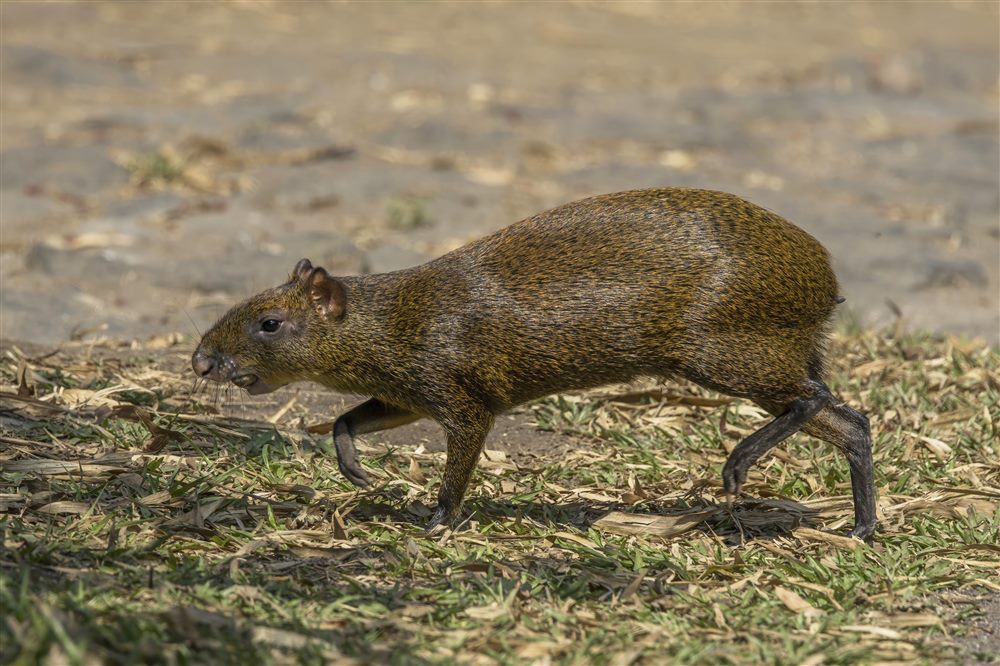
Central American Agouti
Dasyprocta punctata
What if it disappeared?
Impact HighAgoutis immediately stop stealing and re-caching each other's seeds: the relay that once carried a palm seed more than 749 m, one stolen cache at a time, comes to a halt. The large seeds it was the only animal able to carry that far now stay wherever they fall, right under the parent tree.
DocumentedDetail
Jansen, P.A., Hirsch, B.T., Emsens, W.-J., Zamora-Gutierrez, V., Wikelski, M. et Kays, R.W. (2012). Thieving rodents as substitute dispersers of megafaunal seeds. Proceedings of the National Academy of Sciences, 109(31), 12610–12615.
By fitting 500 palm seeds with radio tags, the authors tracked their fate on Barro Colorado Island: each seed was moved an average of 8 times by different agoutis stealing from each other's caches, and 35% ended up more than 100 m from the parent tree — one seed was even re-cached 36 times, traveling over 749 m. This relay replaced, through small cumulative steps, the long-distance transport once provided by now-extinct megafauna. Without agoutis, that relay stops at once: no other forest animal picks up this chain of stealing and re-caching for these large seeds.
Ten years without that relay, forest regeneration suffers: a study shows that when mere fear of ocelots already makes agoutis less active at dispersing and pilfering seeds, regeneration feels the effect. With agoutis fully gone, that activity would drop to zero rather than simply slow down, and young palms grown from seeds carried far from the parent tree would become scarcer.
ExtrapolatedDetail
Extrapolation à partir de Gálvez et Hernández (2022), qui montrent qu'une activité de dispersion réduite par la peur du prédateur affecte déjà la régénération forestière — pas la disparition complète de l'espèce elle-même.
The authors observed lower seed dispersal and pilferage at sites perceived to have high ocelot density, then confirmed the effect with an experiment exposing agoutis to ocelot urine and feces — fear alters foraging behavior, which in turn shapes forest regeneration. The study only measures reduced activity, not total disappearance; the reasoning assumes the effect extends to the complete halt seen after ten years without agoutis.
What's missing to confirm it: No study measures forest regeneration over ten years at a real site with no agoutis at all — only the effect of activity reduced by fear of a predator is measured.
A century without agoutis, the large seeds only they used to spread over long distances would stay clumped under their parent trees instead of scattering across the forest: young palms would likely struggle to establish far from these starting points, since no other animal seems able to take over this chain of stealing and re-caching across such distances.
HypothesisOver a thousand years, this loss of long-distance mixing would likely leave palm populations more clustered around their parent trees than they would have been with agoutis around — even if other rodents partly took over its dispersing role, none seems to replicate this chain of stealing and re-caching over such long distances, and the forest landscape would keep that mark.
HypothesisDocumentation
-
IUCN Red List — Dasyprocta punctata, statut de conservation
Accessed August 14, 2026
-
Jansen et al. (2012) — Thieving rodents as substitute dispersers of megafaunal seeds, PNAS
Accessed August 14, 2026
-
Gálvez & Hernández (2022) — Ecology of fear and its effect on seed dispersal by a neotropical rodent, Behavioral Ecology
Accessed August 14, 2026
Last verified: August 16, 2026